Quantum Information Science
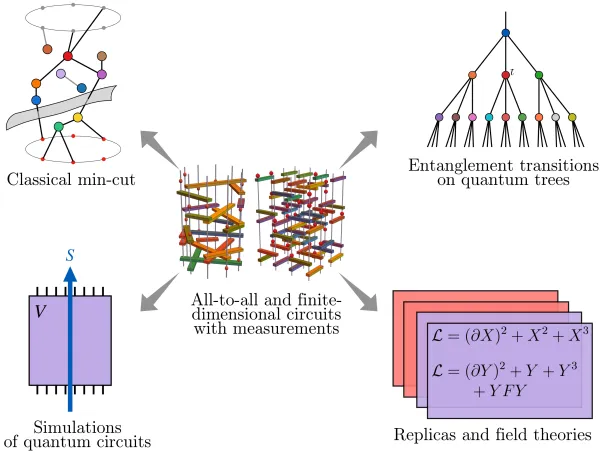
Quantum Information Science (QIS) research in the Department of Physics at The Ohio State University spans foundational studies of quantum mechanics and the development of technologies for computation, communication, and sensing. Faculty and students investigate how quantum coherence, entanglement, and measurement emerge in complex systems, how they can be characterized and controlled, and how these insights can inform the design of quantum devices and networks. This work draws from across the department, bringing together theory and experiment across multiple research areas.
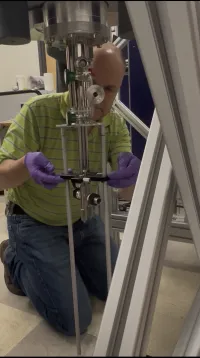
Current efforts span complementary quantum hardware platforms and interfaces, as well as studies of how quantum-information concepts illuminate fundamental physical processes. Representative experimental and theoretical research projects include trapped neutral-atom systems assembled and controlled with laser cooling, optical trapping, and high-resolution optical techniques; solid-state approaches such as superconducting circuits and spin-based quantum degrees of freedom in materials (including quantum point defects and other engineered spin centers); and molecular and hybrid platforms that combine tailored chemistry with precision control. The department also pursues quantum magnonics and related many-body phenomena in magnetic materials, and investigations of quantum correlations in nuclear and high-energy systems, including entanglement within atomic nuclei. Across these directions, researchers use quantum optics and spectroscopy, advanced materials synthesis and nanofabrication, and quantitative modeling to create, manipulate, and read out nonclassical states. Complementing experimental work, theory and computation address quantum algorithms and simulation, open-system dynamics, and error mechanisms, with strategies for mitigation, benchmarking, and robust operation in noisy environments.
QIS activities at Ohio State are strengthened by close ties to campus-wide initiatives coordinated by the Center for Quantum Information Science and Engineering (CQISE) and by collaborations with national laboratories and industry partners. Experimental programs combine precision optical measurements with nanofabrication and advanced instrumentation to probe and engineer quantum behavior, while theory and modeling guide device design and interpret complex quantum dynamics. Graduate students typically engage in research that bridges fundamental questions and practical implementation—developing experimental techniques, building and testing hardware, or creating theoretical and computational tools—and benefit from an environment that supports interdisciplinary training. Collectively, these efforts contribute to quantum technologies and fundamental studies relevant to secure communication, distributed quantum networks, and quantum-enhanced metrology.
Faculty
Ezekiel Johnston-Halperin, Professor
Ph.D. Physics, University of California, Santa Barbara 2003
- Condensed Matter Experiment: Spin Dynamics, Nanoscale Magnet
Yuan-Ming Lu, Professor
Ph.D., Physics, Boston College, 2011
- Condensed Matter Theory
- Topological phases
- Frustrated magnetism and quantum spin liquids
- Unconventional superconductivity
- Quantum phase transitions beyond Ginzburg-Landau framework
- Correlated electronic materials
Kevin Singh, Assistant Professor, John W. Wilkins Endowed Professorship of Physics
Ph.D. Physics - University of California, Santa Barbara, 2019
- Quantum Information
- Atomic, molecular, and optical physics
- Quantum optics
Brian Skinner, Associate Professor
Ph.D. Physics - University of Minnesota - 2011
- Condensed matter theory
- Quantum materials
- Disordered networks