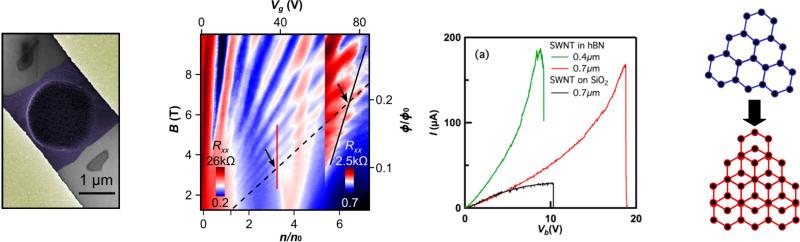
We will discuss a number of our ongoing research projects aimed at understanding the properties of low-dimensional systems such as graphene, carbon nanotubes, and two-dimensional material heterostructures. We first measure the quality factor Q of electrically-driven few-layer graphene drumhead resonators, providing an experimental demonstration that Q~1/T, where T is the temperature. Because the resonators are atomically thin, out-of-plane fluctuations are large. As a result, we find that Q is mainly determined by stochastic frequency broadening rather than frictional damping, in analogy to nuclear magnetic resonance. Our results contribute towards a general framework for understanding the mechanisms of dissipation and spectral line broadening in atomically thin resonators. In addition, recently several research groups have demonstrated placing graphene on hexagonal BN (hBN) with crystallographic alignment. This not only creates a protected environment yielding high-mobility devices, but also due to the resulting superlattice formed in these heterostructures, an energy gap, secondary Dirac Points, and Hofstadter quantization in a magnetic field have been observed. In these systems, we observe a p Berry’s phase shift in the magneto-oscillations when tuning the Fermi level past the secondary Dirac points, originating from a change in topological pseudospin winding number from odd to even when the Fermi-surface electron orbit begins to enclose the secondary Dirac points. We also observe a distinct hexagonal pattern in the longitudinal resistivity versus magnetic field and charge density, resulting from a systematic pattern of replica Dirac points and gaps, reflecting the fractal spectrum of the Hofstadter butterfly. Moreover, carbon nanotubes have been demonstrated to be a nearly ideal system for studying the physics of electrons confined to one dimension. We have encapsulated carbon nanotubes by hBN. We find that these encapsulated nanotube devices are capable of carrying a substantially larger current than those supported on conventional substrates. We attribute this to hBN’s large in-plane thermal conductivity in conjunction with the encapsulation geometry to enable efficient device cooling. Finally, we study the properties of additional graphene/hBN layer structures such as twisted trilayers that are comprised of AB-stacked bilayer graphene contacting a graphene monolayer through a twist angle, coupling the massive bilayer spectrum to that of the massless monolayer spectrum. The interlayer interactions and screening produce a nonlinear monolayer graphene capacitance, and in a magnetic field enable Landau level spectroscopy to be performed. Our latest results will be discussed.