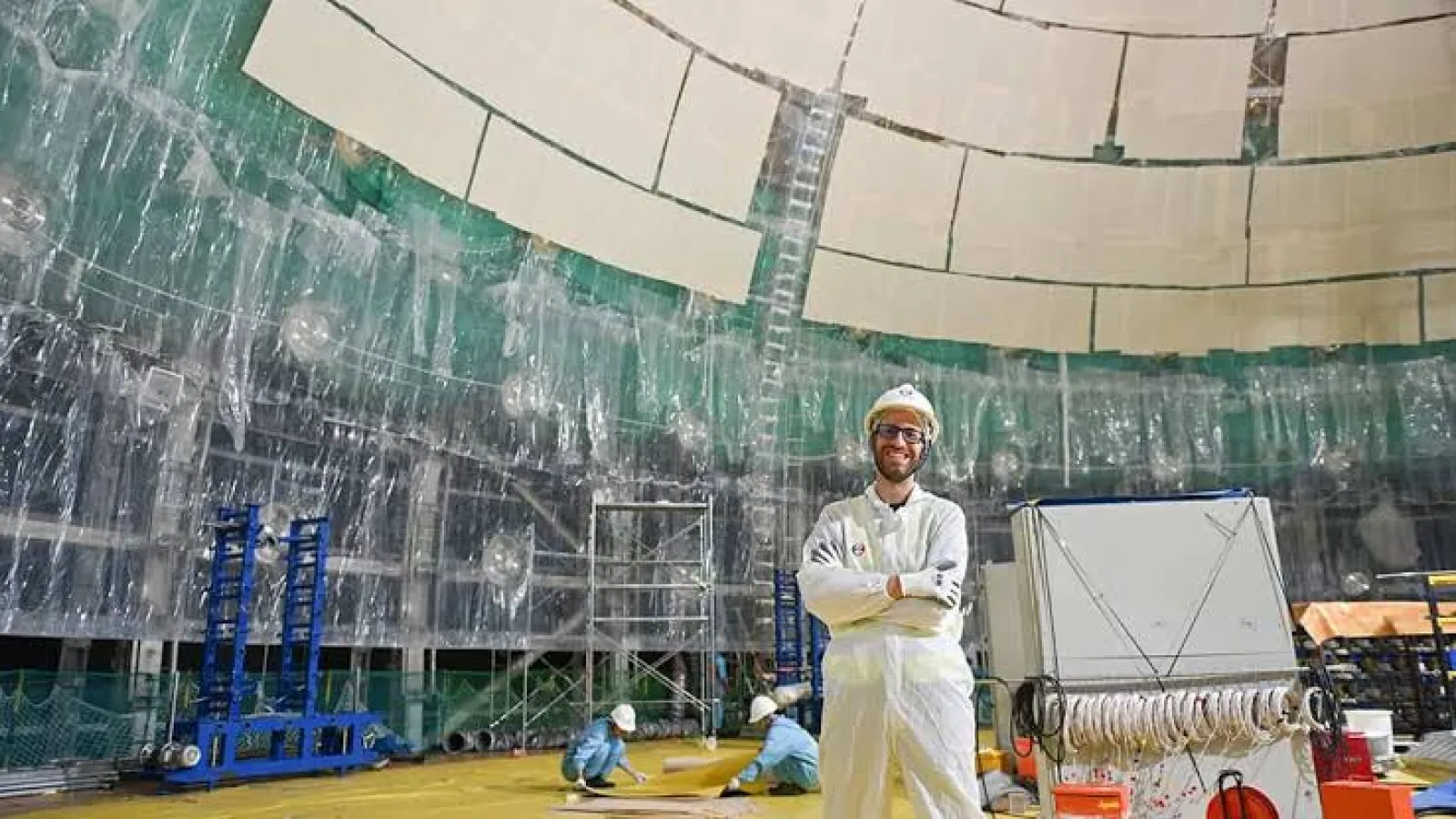
Colloquium: Juan Pedro Ochoa-Ricoux
Using Nuclear Reactors to Probe Neutrino Oscillations: Latest Results from JUNO
Event Details:
- Time: 3:45 - 4:45 PM
- Location: 1080 Physics Research Building
- Faculty Host: Zoya Vallari
Abstract
Neutrinos are elusive particles with unique properties that offer key insights into the
fundamental structure of matter and the cosmic sources that produce them. The Jiangmen
Underground Neutrino Observatory (JUNO) is a next-generation, 20-kiloton liquid scintillator
detector, the largest of its kind in the world, that studies neutrinos emitted by eight nuclear
reactors in southern China, as well as by other terrestrial and cosmic sources. The experiment
recently began operations after more than a decade of design and construction. In this talk, I will
briefly review the state of the field and present our latest results, which provide world-leading
measurements of three neutrino oscillation parameters and the first indication of the ordering
of neutrino masses involving reactor neutrinos. I will also briefly outline JUNO’s broader physics
program and the experiment’s prospects.
Bio
Juan Pedro Ochoa-Ricoux is a Professor in the Department of Physics and Astronomy at the University of California, Irvine. He is an experimental particle physicist whose research focuses on understanding neutrino properties and the cosmic sources that produce them, primarily through experiments using neutrinos from nuclear reactors and particle accelerators.
He received his PhD from Caltech in 2009, where he worked on the MINOS long-baseline neutrino experiment. He then joined Berkeley Lab as a Chamberlain Fellow, where he co-led the installation, commissioning, and data analysis of the Daya Bay Reactor Neutrino Experiment, which made the first precise measurement of one of the fundamental neutrino mixing parameters. In 2013, he joined the faculty of the Pontificia Universidad Católica de Chile, where he expanded his work on reactor neutrinos through the JUNO experiment while also contributing to the ATLAS experiment at CERN and helping pioneer the novel LiquidO neutrino detector concept. He joined UC Irvine in 2019 and currently holds leadership roles in the international JUNO and DUNE collaborations.
He is a two-time co-recipient of the Breakthrough Prize in Fundamental Physics for his contributions to the Daya Bay and ATLAS collaborations and has received the International Partnership Prize from the Chinese Academy of Sciences.