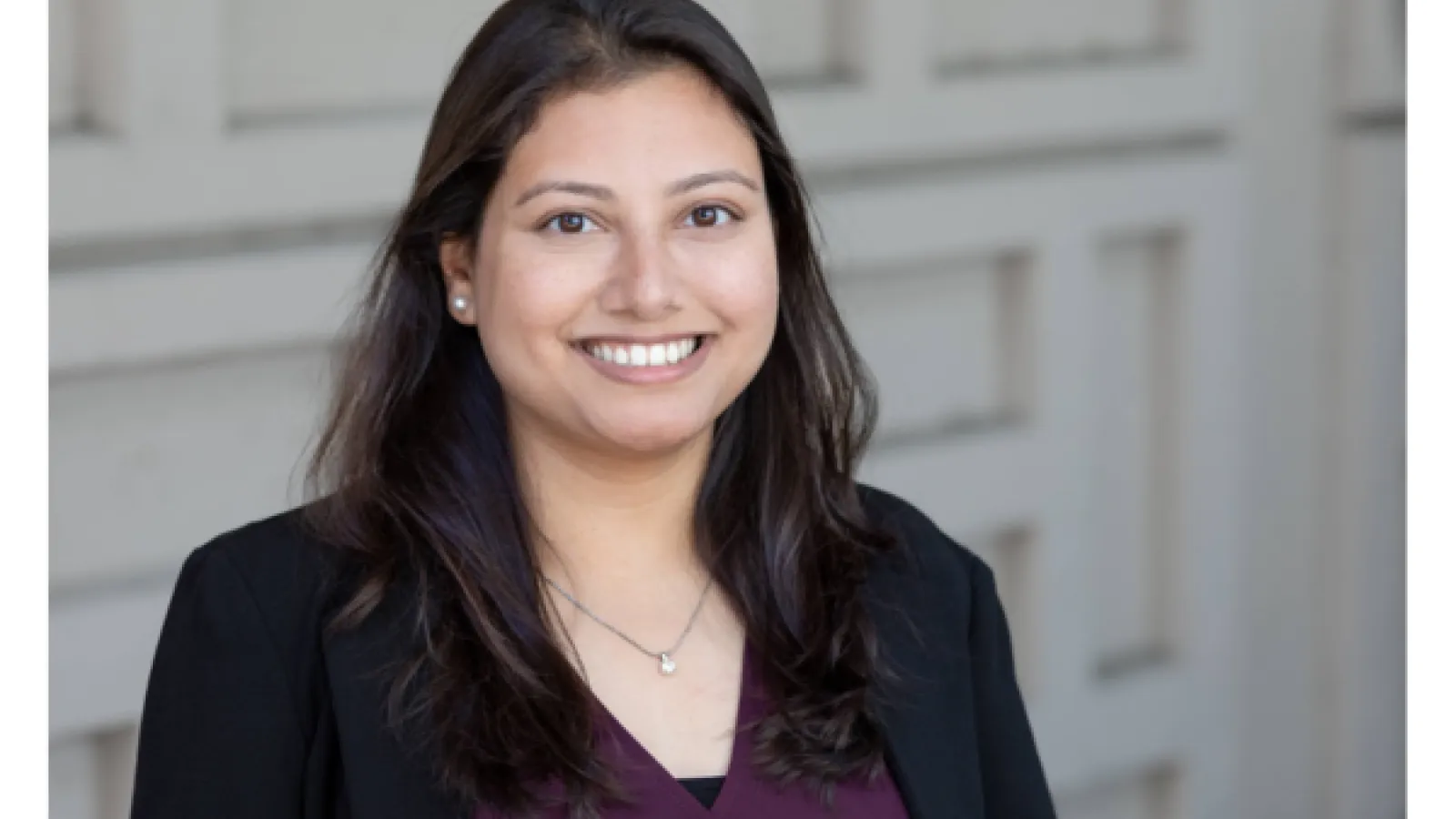
Colloquium: Samhita Banavar, Princeton University
Mechanical Organizing Centers in Living Matter
Event Details:
- Date: February 24, 2026
- Time: 10:00 - 11:00 AM
- Location: 1080 Physics Research Building
- Faculty Host: Michael Poirier
Abstract
Living systems reliably build complex form while growing far from equilibrium, raising a fundamental question shared by physics, biology, and soft matter: how do local interactions and constraints give rise to robust large-scale structure? In this colloquium, I present a physics-based framework that views cells, tissues, and developing organs as active materials shaped by mechanics, transport, and geometry. Using continuum mechanics and fluid-dynamical ideas, I show that growth is often organized by localized, dynamically evolving interfaces—Mechanical Organizing Centers (MOCs)—where mechanical stresses, material flows, and biochemical processes intersect. Despite their biological diversity, systems such as polarized yeast cells, elongating tissues, and branching mammalian lungs share common physical features, operating near symmetry-breaking and fluid–solid transitions that confer both robustness and sensitivity. I conclude by outlining a theory-driven program to develop predictive models of growth in organoids and invasive fungal systems and to identify conserved principles by which living matter senses its extent and builds form.
Bio
Dr. Samhita Banavar is a Shurl and Kay Curci Foundation Awardee of the Life Sciences Research Foundation (LSRF) and a postdoctoral fellow in the Department of Chemical and Biological Engineering at Princeton University, where she works with Celeste Nelson. She earned her Ph.D. in Physics from the University of California, Santa Barbara, in the laboratory of Otger Campàs, supported by an NSF Graduate Research Fellowship, and received her B.S. degrees in Physics and Mathematics from the Schreyer Honors College at The Pennsylvania State University. Her research lies at the interface of physics and biology, focusing on the physical principles that govern tissue and organ morphogenesis. She studies how growing biological systems sense size and geometry, and how local mechanical and biochemical interactions and transport at interfaces give rise to robust large-scale form. Her work integrates theoretical modeling with quantitative measurements of tissue mechanics and live fluorescence imaging to uncover conserved mechanisms across length scales. Grounded in theoretical physics and informed by experiment, Dr. Banavar studies how universal physical principles shape biological form and organization.