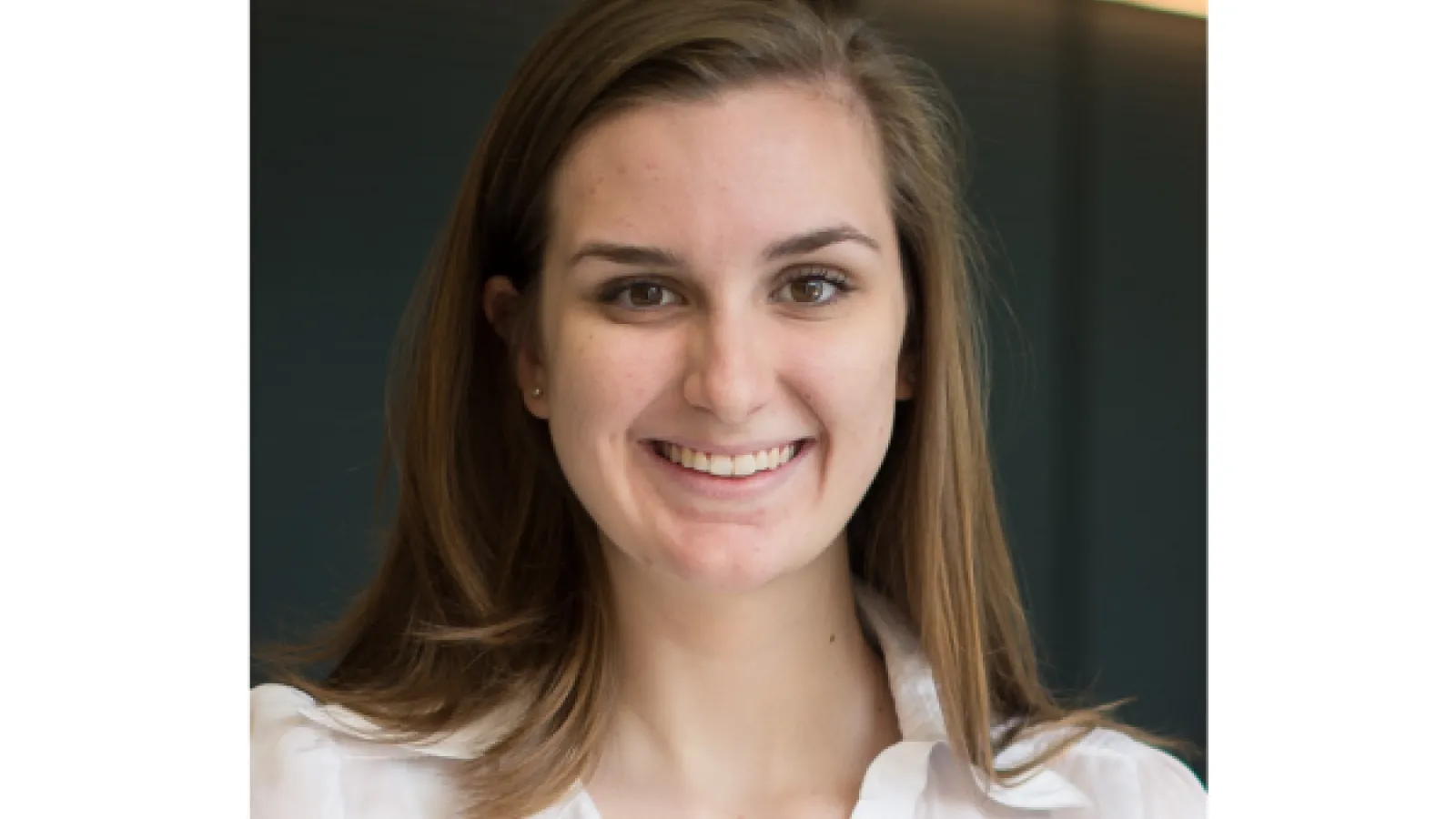
Colloquium: Rikki Garner, Harvard Medical School
The embryo as an active self-organizing machine
Event Details:
- Date: February 12, 2026
- Time: 3:45 PM - 4:45 PM
- Location: 1080 Physics Research Building
- Faculty Host: Michael Poirier
Abstract
Perhaps the most extraordinary and distinctive feature of biological systems is their remarkable ability to self-organize across scales. Millions of macromolecules act in concert to build the cell, and cells in turn arrange into beautiful and complex structures that enable multicellular life. And yet, life at nearly every scale is stochastic: from molecular diffusion and binding, to undulations in cell shape and movement, to surprisingly common errors in gene expression and embryonic development. A fundamental question at the interface of biology and active soft matter physics is how robust form and function can possibly arise from intrinsically noisy biomolecular and cellular interactions. Addressing this question fundamentally requires quantitative, multi-scale approaches, which have presented major challenges both experimentally and theoretically. In this seminar, I will discuss my work combining biophysical modeling and advanced microscopy to identify mechanisms encoding biological self-organization and noise-suppression from the molecular to the organismal scale. Topics include enormous heterogeneity in macromolecular diffusion, how locomoting immune cells control their shape, phase separation phenomena that control tissue patterning, and extreme random cell mixing in the embryo.
Bio
Dr. Rikki Garner is currently a Helen Hay Whitney postdoctoral fellow in the Department of Systems Biology at Harvard Medical School, working with Sean Megason. She previously earned her Ph.D. in Biophysics at Stanford University in the lab of Julie Theriot, supported by NSF GRFP and Stanford Lieberman fellowships, and obtained her B.S. in Physics at the University of Texas at Austin. Dr. Garner’s research investigates one of the most extraordinary and distinctive features of biological systems: their remarkable ability to self-organize across scales. She seeks to understand the mechanisms by which millions of macromolecules act in concert to build the cell, how cells in turn arrange into beautiful and complex structures that enable multicellular life, and how biological noise is suppressed at all scales to give rise to robust form and function. To address this fundamental unsolved problem, Dr. Garner employs quantitative microscopy of experimental models of biological self-organization spanning the molecular, cellular, tissue, and organismal scales – with a particular emphasis on cell migration and embryonic development. Combining quantitative experimental measurements with first-principles biophysical modeling, Dr. Garner aims to forge an integrated understanding of how statistical physics and biology come together to shape and pattern life.