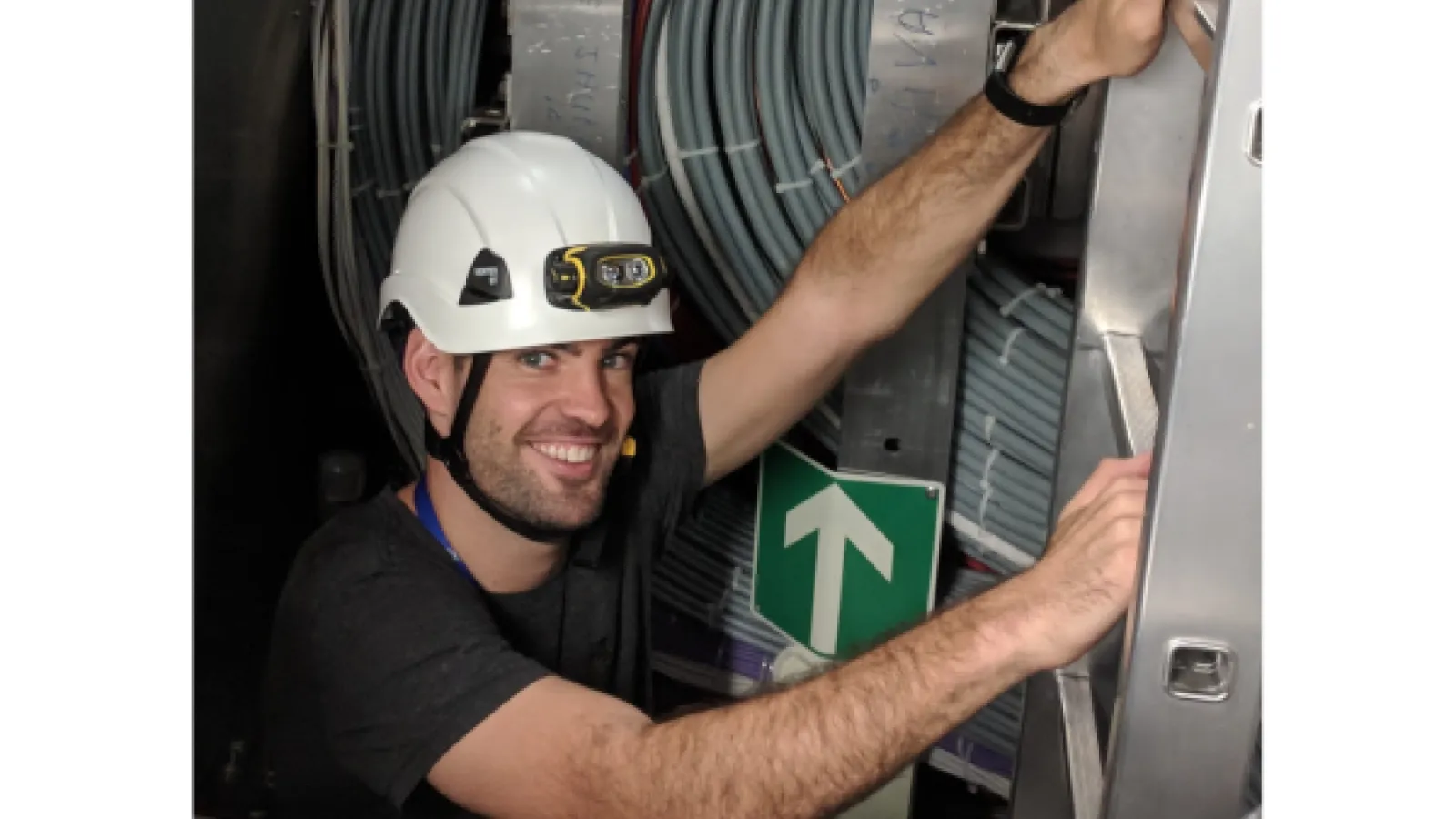
Colloquium: Ian Dyckes, Lawrence Berkeley National Laboratory (LBNL)
Pushing Silicon to Its Limits: Searching for New Physics and Building the ATLAS Inner Tracker
Event Details:
- Date: February 19, 2026
- Time: 3:45 - 4:45 PM
- Location: 1080 Physics Research Building
- Faculty Host: Chris Hill
Abstract
The Large Hadron Collider has been an extraordinary success, delivering the Higgs boson and reshaping our experimental understanding of physics beyond the Standard Model. However, null results in many traditional search channels suggest that new physics may be subtler or more experimentally challenging than originally expected. In this talk, I will discuss how these results motivate unconventional approaches, with a focus on long-lived particle searches via energy loss (dE/dx) measurements in the ATLAS Pixel Detector. I will show how exploiting such signatures pushes this silicon detector towards the limits of its performance, highlighting radiation damage effects and their mitigation. Looking ahead to the High-Luminosity LHC, I will introduce the ATLAS Inner Tracker (ITk) upgrade and use the "Cold Noise" issue it faced as an example of the unexpected challenges that arise when operating complex detectors at the frontier of instrumentation.
Bio
Ian received his PhD from the University of Pennsylvania under the supervision of Evelyn Thomson. As a graduate student, he performed searches for supersymmetry with the ATLAS detector and served as a data-acquisition expert for the ATLAS Transition Radiation Tracker. After completing his PhD, he moved to Lawrence Berkeley National Laboratory, where he joined the ATLAS Inner Tracker upgrade project. He led efforts to qualify LBNL as a silicon strip module production site and spearheaded the investigation of the “Cold Noise” issue observed in these modules. He currently leads searches for new long-lived particles using anomalous ionization and time-of-flight measurements. Beginning in April, he will serve as a convener of the ATLAS Long-Lived and Unconventional Physics group.