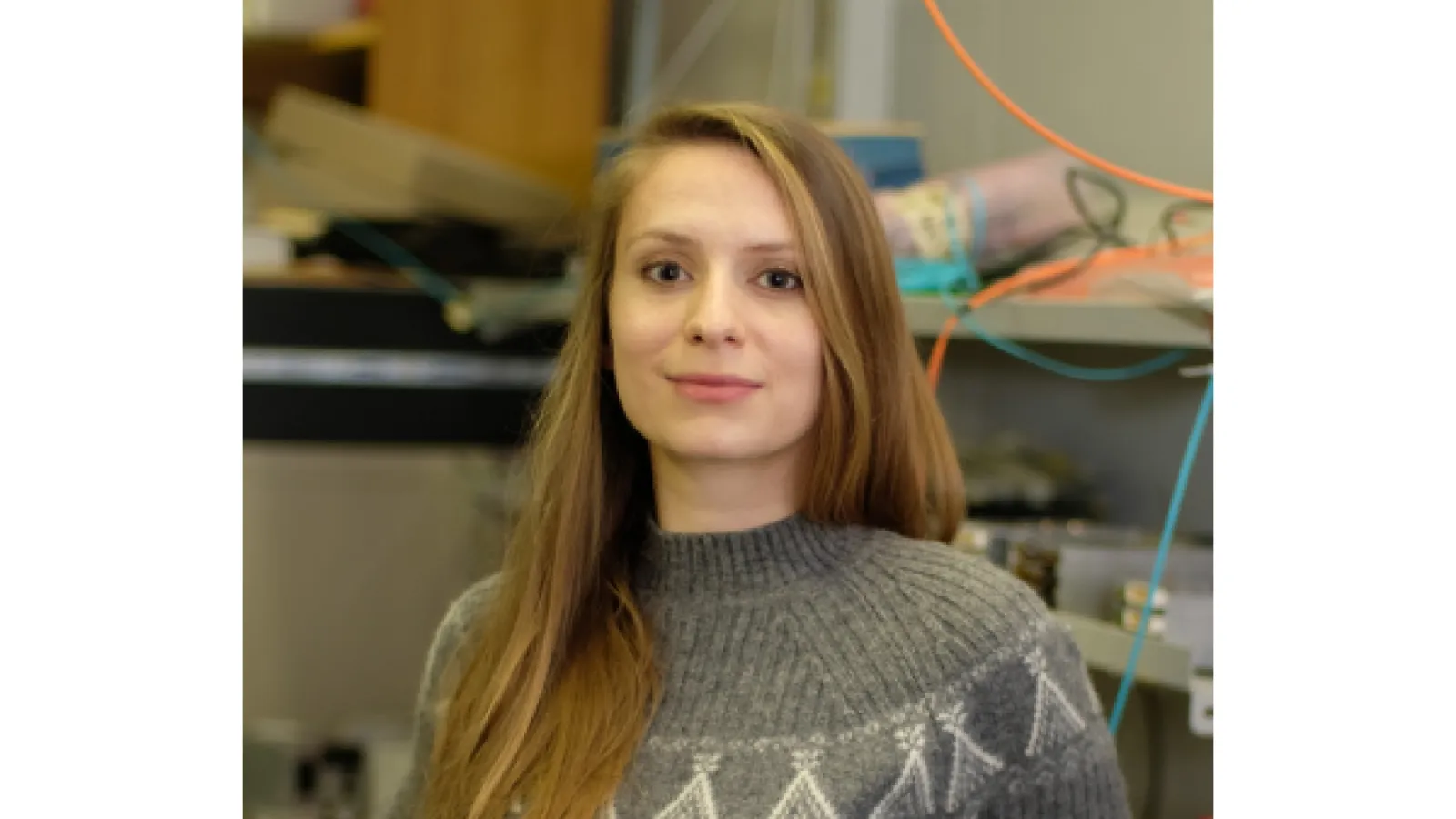
Colloquium: Grace Cummings, Fermi National Accelerator Laboratory (FNAL)
When they go low, we go lower: extending the reach of collider experiments with low-level detector information
Event Details:
- Date: February 5, 2026
- Time: 3:45 - 4:45 PM
- Location: 1080 Physics Research Building
- Faculty Host: Chris Hill
Abstract
Even in the time of streaming and industrial big-data, the experiments at the Large Hadron Collider still produce data of staggering size and rate. To combat this, low-level detector information is often removed, reduced, or recast; however, the lowest-level detector information holds exciting phase space for both beyond the Standard Model searches and precision measurements. I will present the Compact Muon Solenoid (CMS) experiment’s most recent search for heavy stable charged particles (HSCPs) in the tracker using dE/dx information. Characterized by anomalously large ionization energy loss, HSCPs are a signature driven search enabled by the inclusion of low-level information in the readout of the silicon pixels and strips. Looking toward future colliders, the Particle Physics Project Prioritization Panel (P5) recommendation of a Higgs factory demands precision detectors. To meet this challenge, we are developing high resolution homogenous crystal calorimetry through the measurement and separation of scintillation and Cherenkov light -- information that currently is lost in calorimeters like those in CMS. This talk will review our first proof-of-principle measurements collecting Cherenkov and scintillation light in homogeneous crystals preparing for the precision electromagnetic calorimeter layers of the future.
Bio
Grace E. Cummings is a Lederman Fellow at Fermi National Accelerator Laboratory on the Compact Muon Solenoid (CMS) Experiment. Expanding on her experience in exotica searches at the Large Hadron Collider (LHC) and calorimeter readout electronics for the CMS upgrades for the High Luminosity-LHC, Grace has branched out into research and development for precision calorimetry at future colliders. Grace began at Fermilab in 2022 after receiving her PhD at the University of Virginia, in Charlottesville, VA. Grace received her bachelor's of science in physics at Virginia Commonwealth University in Richmond, VA, in 2016. Grace is from Selbyville, DE, and now lives in Chicago.