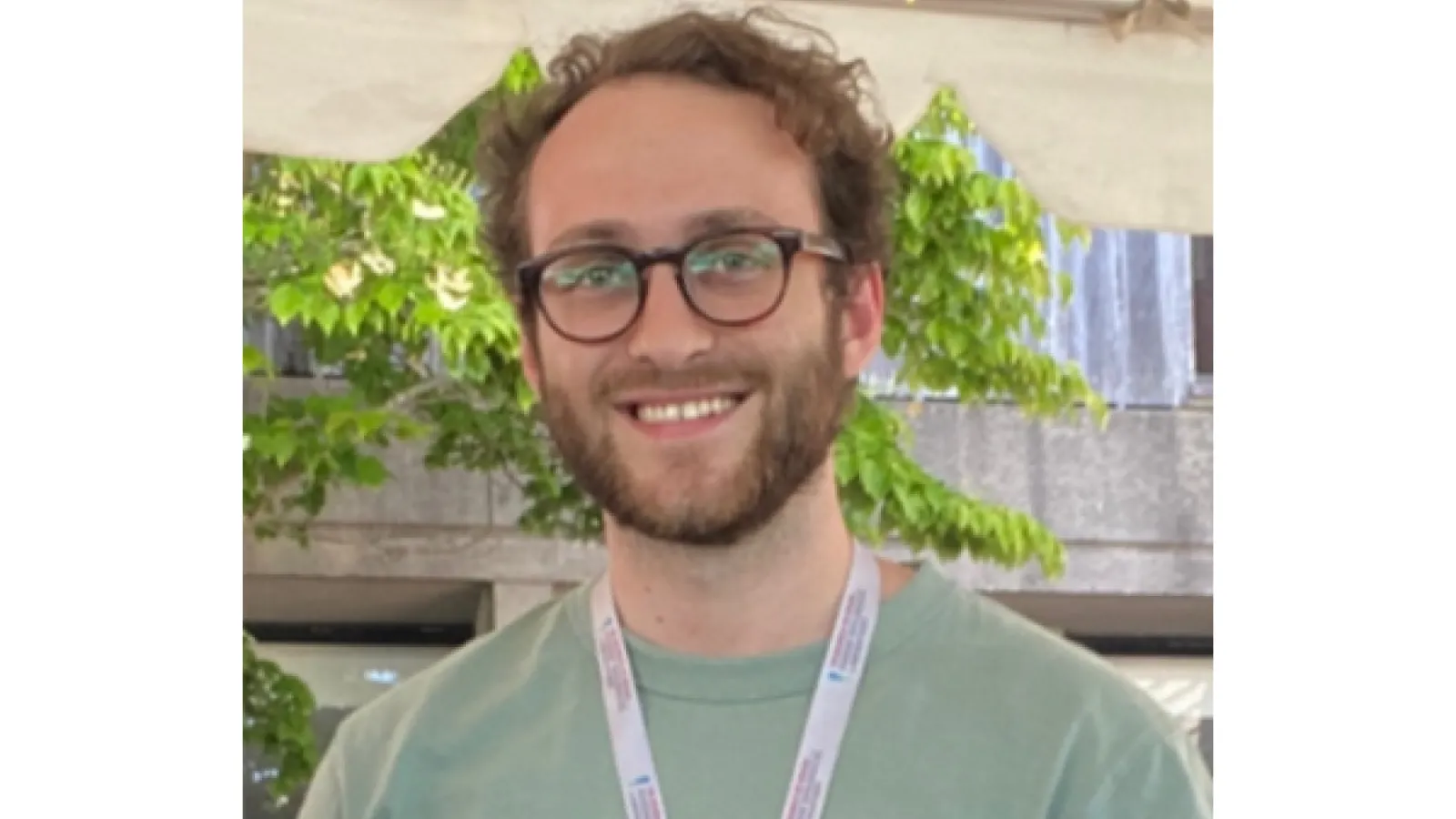
Colloquium: Carlos Floyd, University of Chicago
Limits on the computational expressivity of non-equilibrium biophysical processes
Event Details:
- Time: 3:45 - 4:45 PM
- Location: 1080 Physics Research Building
- Faculty Host: Michael Poirier
Abstract
Many biological decision-making tasks require classifying high-dimensional chemical states, and the biophysical and computational mechanisms that enable classification remain enigmatic. In this talk, using Markov jump processes as an abstraction of general biochemical networks, I discuss several unanticipated and universal limitations on the classification ability of generic biophysical processes. These limits arise from a fundamental non-equilibrium thermodynamic constraint that we have derived. Importantly, I will discuss how these limitations can be overcome using common biochemical mechanisms that we term input multiplicity, examples of which include enzymes acting on multiple targets. Analogous to how increasing depth enhances the expressivity and classification ability of neural networks, this work demonstrates how tuning input multiplicity can potentially enable an exponential increase in a biological system’s ability to classify and process information. I will end by discussing preliminary generalizations to non-linear chemical reaction networks and applications to specific biological coding problems.
Bio
Carlos Floyd is an AI+Science postdoctoral fellow of the Data Science Institute at the University of Chicago, working with Suri Vaikuntanathan and Aaron Dinner. He received his Ph.D. in Biophysics from the University of Maryland, College Park, where he worked with Christopher Jarzynski and Garegin Papoian studying nonequilibrium thermodynamics and self-organization in cytoskeletal networks. His current research studies how active and biochemical systems realize computation and control, using theory, simulation, and machine learning to elucidate how disordered biomolecular collectives can give rise to emergent function.