
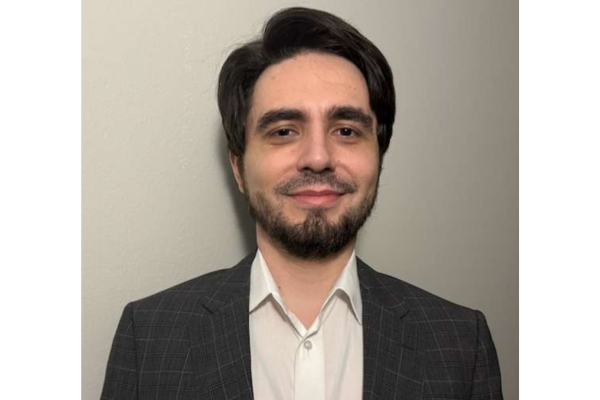
Colloquium: Silviu-Marian Udrescu, Johns Hopkins University
Radioactive Molecules and Quantum Sensing for Fundamental Physics
Event Details:
- Date: February 19, 2026
- Time: 9:00 - 10:00 AM
- Location: 1080 Physics Research Building
- Faculty Host: Sasha Landsman
Abstract
Radioactive molecules containing octupole-deformed nuclei can be extremely sensitive to violations of the fundamental symmetries of nature, having the potential to answer some of the biggest open questions in physics, such as the origin of the matter-antimatter asymmetry in the Universe and the nature of Dark Matter. In this talk, I will present pioneering results in the study of radioactive molecules obtained from laser spectroscopy experiments performed on short-lived radium monofluoride (RaF) molecules, at the ISOLDE facility at CERN. These measurements allowed us to establish a highly effective laser cooling scheme for RaF and to observe, for the first time, the influence of minuscule electroweak nuclear effects on molecular energy levels. These results opened the way for future precision studies and new physics searches using radioactive molecules. Next, I will present ongoing efforts to develop new methods to elucidate how nuclear phenomena emerge from interactions between quarks and gluons. I will discuss the status of a novel experiment aiming to measure parity-violating nucleon-nucleon electroweak interactions using trapped molecular ions. This method promises to provide more than twelve orders of magnitude enhancements in sensitivity relative to analogous atomic experiments. Finally, I will introduce a new experimental platform for trapping and controlling ultracold negatively charged molecular ions. Such systems are expected to open new, exciting research avenues in the study of radioactive atoms and molecules, antimatter, ultracold chemistry, and even quantum computing.
Bio
- 2014-2018: BSc in Physics and Mathematics, New York University Abu Dhabi, UAE
- 2018-2024: PhD in Physics, Massachusetts Institute of Technology, USA
- 2024-2025: Postdoctoral Fellow, The University of Chicago, USA
- 2025-Present: Assistant Research Scientist, Johns Hopkins University, USA